 Just Frances T
[I wrote this several months back and never got around to posting it. I thought of it again when I had a similar nightmare about preaching two nights ago.]
I had my first nightmare about preaching recently. It was funny to me because I get nervous about public speaking, but not as much as it seems to bother most people. It’s hardly a nightmare-worthy topic for me in general.
In my dream, I was a guest speaker somewhere, perhaps a retreat (since it was pretty late at night). I spoke once and before I got up to speak a second time, I realized I didn’t know what I was going to say. I waffled between two passages until it was time to get up and speak. When I got up, I noticed that there were only a handful of people left from the first session; most of them had already left. Then I woke up in a cold sweat. Read More
As I’ve graduated from seminary (it’s still weird to say that) and have began my pastoral internship, I’ve noticed an alarming trend in myself. I like call it “Image Management.” It sounds pretty innocuous, like the name of a PR firm, but it is far from harmless.
Image management is the strong temptation to manage the way others perceive me. It’s the desire to hide bad stuff and publicize my better qualities. We all do this to some degree.
Pastors have an especially high temptation to try and look good because that’s what parishioners expect. There’s the added pressure of not screwing up when the world is watching and waiting for yet another pastor to tumble down in flames.
Recently, certain situations have forced me to realize how selfish I am. Read More
I finished teaching a six-week class on worship last week. The curriculum focused on different characteristics of God as the basis for our worship. Each week, we had a discussion about one aspect of God based in Scripture (e.g. creator). In addition, the participants were given different spiritual disciplines and practices to do as homework to deepen their understanding of that week’s aspect of God (e.g. contemplating God in nature).
I have to confess that this was one of the most challenging courses I’ve taught. I originally wanted to do lots of cool experiential things, but was limited by time and resources. Instead, I had to rely on the fact that if I pointed people (including myself) to God, they would meet him and worship. And indeed we did. Read More
I haven’t talked about my forget-me-nots in a while, but I’ve still been learning from the process of growing them the past few months.
Lesson #3, “Diversity”
The third thing I noticed about growing plants from seed is that all of the seedlings looked different from one another. They were all the same plant, but each one took on its own shape and size. Some had a bunch of leaves; some had two or three. Some crept along the ground; some grew taller than the others. Even the same seedling had leaves of different sizes and shapes. They were all the same plant, yet each was unique in the appearance it took.
I spent last week serving at my church’s amazing Vacation Bible School, mostly in the crafts station. Staying in one station, I had the opportunity to interact with hundreds of kids. I noticed quickly how distinct they were from one another. They had different personalities, strengths, and needs. Some were outspoken, others shy. Some were creative, others couldn’t have cared less about crafts.
They had different needs, but all of them responded positively when the leaders recognized their needs and treated them accordingly. I also noticed that they lit up when I called them by name. They really lit up when I told them what their name meant, like they discovered some treasure about themselves.
Such as it always is growing all disciples. We are all followers of Christ, filled with the Holy Spirit, but we are very different. We have different personalities, strengths, and needs. A strong discipler knows how to listen to others and to see them, even when they can’t truly see themselves.
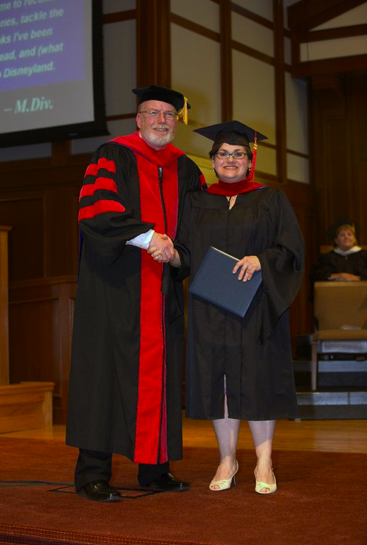
It has been ages since I’ve updated my blog. I’ve had the best of intentions, but graduation responsibilities and computer problems have conspired to keep me away from the internet for the past few weeks. In order to ease back into the habit of posting, I’m starting with my speech that I shared at graduation on June 26.
“It was the best of times, it was the worst of times, it was the age of wisdom, it was the age of foolishness…it was the epoch of incredulity…it was the spring of hope, it was the winter of despair”
When Charles Dickens penned these famous words, he was referring to a Revolution. I have found them to be just as true of my seminary life, which was also a revolution of sorts. I walked into seminary six years ago with a smirk and a swagger and bright red punk rock hair (that I still think is pretty cool), sure that I knew everything I needed to know for ministry. I just needed my degree.
That was then. Read More
I have to confess that it took me so long to get back to writing about Gospel-centered preaching because I have been doing research for one of my last seminary papers: a theology of women in ministry. Even when I’m not supposed to be doing research, I’ve come across stuff in unexpected places. I just can’t get away from it!
Doing research for this paper has been a painful experience. Not the typical lots-of-work kind of pain, but a deep personal pain related to wrestling with an issue that cuts close to my identity and calling. This wrestling is a good experience, but it has often been made all the more painful by insensitivity of those who write about and discuss this topic.
With that in mind, I have a few thoughts about how to handle this issue, regardless of what you believe about the roles that are available to women in ministry.* Read More
Finally, part 3 of my posts from way too stinkin’ long ago. I actually had to stop and think a moment about how to post something on my blog. Way. Too. Long. Between. Posts.
“How NOT to Preach” is a misnomer for this post, since I really hope that people will opt for Gospel-centered preaching, but I kept the title since this is part of the series I started so long ago.
What exactly does Gospel-centered preaching mean? Essentially, it means that the heart of the message is the Gospel. Not necessarily an altar call, but something that brings us to the heart of the Good News: our sin and inability to save ourselves face-to-face with Jesus’ redemption and triumph.
The focus shifts from ourselves to our Savior. Read More
This is part two of my post from yesterday.
Many people I know would never intentionally preach the prosperity gospel, though we often live as if it were true. I know many Christians whose faith was dashed on the rocks of life’s pain and troubles. Any preaching that fails to account for the fact that life is difficult, even (especially) as a Christian, sets us up for failure.
I humbly submit that the second type of sermon that we should avoid also sets the congregation up for failure because it focuses on the wrong things: our works. The second way to NOT preach is the Guilt Gospel.
The guilt gospel boils down to the message that you need to do more. To be a good Christian, you need to serve more, give more, read the Bible more, follow these 3-5-10-(infinity) easy steps to spiritual growth. If you’re not growing, you’re not doing enough.
Or, you tell the congregation that they need to be more. They’re not good enough people and need to try harder to emulate Biblical heroes.
I’m taking a class on Preaching and Writing about Gospel-Centered Transformation this semester and am deeply indebted to my professor, Dr. Jeff Louie for the root of this post.
As we discuss preaching the Gospel message in my class, we also learn how not to preach. It’s a fun exercise to write “wrong” outlines and hear inappropriate points, but it also helps us to know the difference between Gospel-centered preaching and other ways people can preach. It’s also quite indicting to think back on my own messages in light of what I’m learning, yikes!
The first style we practiced was preaching in the Propserity Gospel style. You know this style: preaching health and wealth, positive confession, name it and claim it, blab it and grab it.
We learned that the heart of this method is to universalize non-normative deliverances into everyday occurrances and/or promises from God.
I know, that sentence says a lot, but it boils down to promising that every positive, miraculous deliverance in the Bible is what God intends for our life Read More
Back in the day, I didn’t think much of Eugene Peterson. I also didn’t know much about him. All I knew about him was that he had written The Message paraphrase of the Bible, which wasn’t the most accurate version. I’ve read a couple of his books for school now and I really like his writing. He says many counter-cultural things about church leadership and being a pastor. My discipleship teacher introduced the following Peterson quote to us this week:
People are uncomfortable with mystery (God) and mess (themselves). They avoid both mystery and mess by devising programs and hiring pastors to manage them. A program provides a defined structure with an achievable goal. Mystery and mess are eliminated at a stroke. This is appealing.
In the midst of the mysteries of grace and the complexities of human sin, it is nice to have something that you can evaluate every month or so and find out where you stand. We don’t have to deal with ourselves or with God, but can use the vocabulary of religion and work in an environment that acknowledges God, and so be assured that we are doing something significant. We set a goal, work out a strategy, recruit a few Christian soldiers, and go to it.
If, in two or three years the soldiers haven’t produced, we shake the dust off our feet and hire on as captain to another group of mercenaries. When a congregation no longer serves our ambition, it is abandoned for another under the euphemism of ‘a larger ministry.’ In the majority of such cases, our impatience is rewarded with a larger salary.”
– Eugene Peterson, The Contemplative Pastor : Returning to the Art of Spiritual Direction Read More
 Frances
 Just Frances T